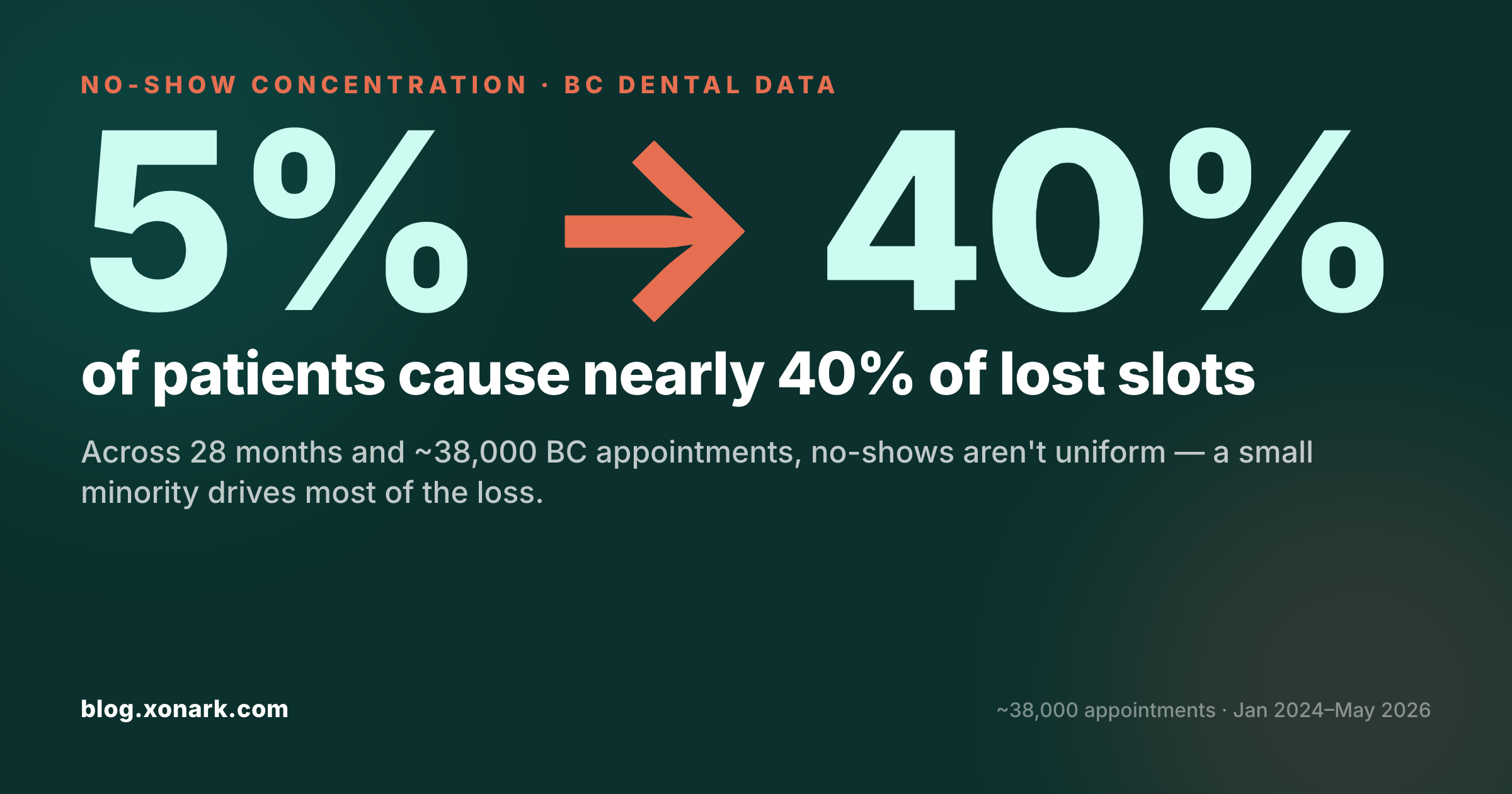
5% of dental patients account for nearly 40% of lost slots
· Jack Jia · 6 min read
- xona
- dental
- no-shows
- production-data
Most dental practice-management writing treats no-shows as a population problem. “Patients no-show 8% of the time.” “Reduce no-shows with better reminders.” The implied model is that every patient carries roughly the same risk and the practice tries to shave a percentage point off it through systems.
That model is wrong, and the data we have in front of us is wrong by such a wide margin that the advice that flows from it — reminder cadence, deposit policies, double-booking strategy — is mostly built on the wrong target.
Source: ~38,000 appointments, 6,800+ unique patients, January 2024 through May 2026, across anonymized BC general dental practice appointment datasets. “Lost” here means the appointment was on the schedule with a patient on it, and the patient did not arrive (no-show) or the appointment was cancelled. ±10% windowing where exact numbers would identify a practice.
The shape of the distribution
If we group patients by how many of their scheduled appointments they lost in the window:
| Lost appointments in 28 months | Share of patients | Share of all lost appointments |
|---|---|---|
| 0 | ~60% | 0% |
| 1 | ~27% | ~30% |
| 2 | ~9% | ~26% |
| 3–5 | ~4% | ~30% |
| 6+ | ~0.4% | ~8% |
Shares are rounded to whole percentages, so the “share of all lost appointments” column reflects approximate, windowed figures and won’t sum to exactly 100%.
The takeaways from this single table:
- About 60% of patients lose zero appointments in 28 months. This is the silent majority. Reminder systems, deposit policies, double-booking — none of these are doing anything for this group and they don’t need it. Investing more front-desk attention in this group has limited marginal return.
- The bottom ~5% of patients (3+ losses) account for nearly 40% of all losses. That’s a power-law tail. A single repeated-loss pattern in this group can matter as much as dozens of low-risk patients.
- About 13% of patients account for over half of all losses. If a practice could identify these 13% in advance and apply a different policy to just them, it would address the majority of its no-show problem without changing the experience for anyone else.
The implication is that the right unit of intervention is the patient, not the appointment. Practices commonly do the reverse — uniform reminder policy applied to every appointment, light-touch even for the patient who has already lost three in a year.
Why uniform reminders are leaving money on the table
A basic reminder workflow treats every patient the same: one templated SMS at the same lead time, regardless of who the patient is or how their history looks. Whether the patient has never missed an appointment in their life or has missed five in the last year, the message and timing are identical.
For the ~60% of patients with zero losses in two-plus years, this reminder is friendly noise — possibly useful, definitely not preventing anything. For the 13% who account for the majority of losses, a single 24-hour SMS is the wrong tool entirely. These patients are not failing to show because they forgot. They’re failing to show because their schedules genuinely change more often, and a friendly reminder doesn’t change that.
A smarter version would tier the reminder track by patient history:
- Tier A (zero losses in 24 months): keep the current single-send reminder. Don’t overserve.
- Tier B (1–2 losses): add a confirmation request — replyable, threaded back to the front desk. The patient has to actively answer.
- Tier C (3+ losses): confirmation request and a flag to the front desk three days out, with the option to require a deposit, double-book the slot defensively, or call the patient personally.
The point is not that this exact tiering is the final answer. The point is that a uniform policy is the wrong default when 5% of the population produces nearly 40% of the cost.
What this means for staffing the front desk
If we accept the power-law shape, the next observation is about where front-desk attention should go. Most front desks try to confirm every appointment for tomorrow. That’s an enormous amount of work for very little marginal benefit on the well-behaved majority.
A better distribution of front-desk effort, derived from the same data:
- Tomorrow’s Tier A appointments: assume they’re showing. Skip the call. Confirm via SMS only.
- Tomorrow’s Tier B appointments: SMS confirmation; if no reply by end-of-day, the front desk calls.
- Tomorrow’s Tier C appointments: front desk calls today, not tomorrow. Three days out, not one. These patients need the conversation, not the nudge.
For a typical day’s schedule of 30 appointments, this might mean the front desk makes 4–5 confirmation calls (the Tier C and unanswered Tier B) instead of 30. That’s a real reclaiming of staff time, and it gets spent on the patients where it matters.
What we don’t know yet from this data
Two questions the current dataset doesn’t answer directly:
Whether the pattern is stable over time. A patient in Tier C this year might be in Tier A next year — life changes, schedules change. We have not yet measured the year-over-year transition matrix between tiers. Until we do, any tiering policy should reassess membership periodically (probably quarterly).
Whether the 5% are predictable from non-history signals. If a brand-new patient walks in, they have no loss history. The tiering system above defaults them to Tier A. Is that right? A separate question — predicting first-appointment no-show risk from demographic/booking signals (age, lead time, recall vs treatment) — is what we’ll look at in subsequent posts.
The honest accounting
The cleanest sentence from this analysis is:
In a dental practice’s no-show problem, most patients are not the problem. The problem is concentrated in a small minority whose pattern would be visible to any system that bothered to look at patient history before scheduling the next reminder.
Many reminder workflows still default to uniform sends, with maybe a practice-level “confirmation requested” toggle. The data above is the case for changing that default.
The product lesson for Xona is not “send more reminders.” It is: make the risky work visible early, thread patient replies back to the front desk, and focus human attention on the small group of appointments that can actually hurt the day.
The next post in this series tests a stubborn folk theory: rainy days — even storm days — do not increase no-show rates in this dataset. Several common beliefs about why patients fail to show do not survive contact with the data.