What patients actually want from a dental phone line
· Jack Jia · 11 min read
- xona
- dental
- patient-experience
- production-data
When we started building Xona, we spent the first three months arguing about which calls were the “valuable” ones. New-patient acquisition calls — yes, obviously. Reschedule requests — probably. What about the patient asking what time the office opens tomorrow?
That third question turned out to matter more than we expected.
Aggregated across four active Canadian dental practices in production. Practice names omitted. The 60-day window below is a snapshot; lifetime usage is much larger. Metrics verified against production data on 2026-05-11.
The four practices behind these numbers
| Practice (anonymized) | Dental software | Live since | Lifetime calls handled |
|---|---|---|---|
| Toronto-area implant-focused practice | Oryx | Aug 2025 | ~763 |
| Downtown Victoria family practice | ClearDent | Oct 2025 | ~295 |
| Lower Mainland family practice | ClearDent | May 2025 | ~237 |
| Large Vancouver-area GP practice | Tracker | Mar 2026 | ~15 (recent) |
All four are still in production at the time of writing. The numbers below come from a 60-day sampling window across all of them.
A 24-second call that explains the whole thesis
This is a real call from one of the four practices, on the evening of April 28. Patient names and the clinic’s identifiers have been redacted at the source.
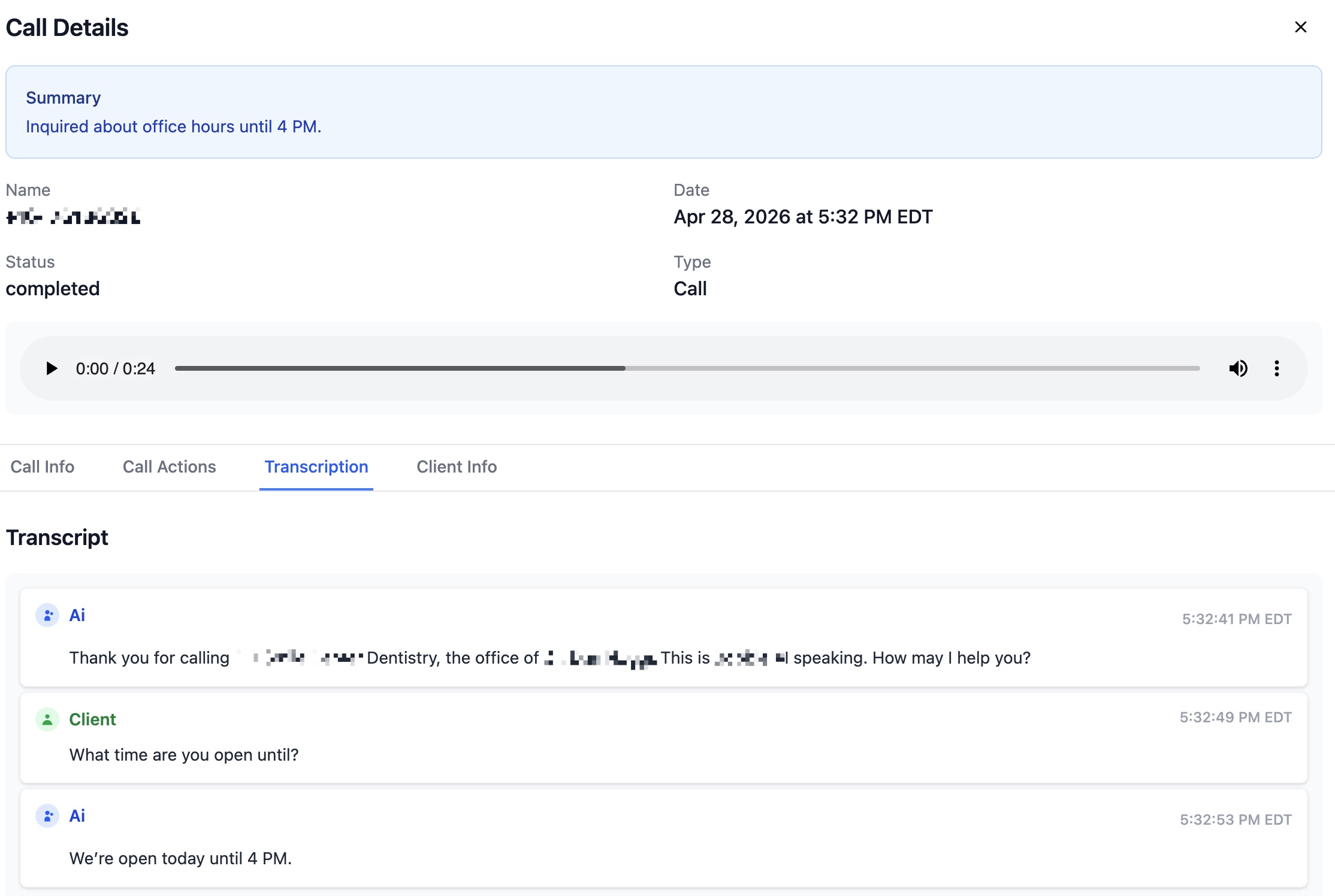
A live call from Apr 28, 2026, 5:32 PM local time — eight minutes after the office’s listed close. The patient asked one question and got one answer. Patient name, clinic name, and the AI’s chosen receptionist name are blurred at the source. Screenshot taken 2026-05-11.
The patient asked a question. They got a correct answer. They hung up. The whole exchange was 24 seconds.
What would the alternative have looked like? The office was closed. The call would have gone to voicemail. The patient would have either tried calling again the next morning, or — more likely — looked up “dentist near me” because they wanted an answer tonight. That’s not a hypothetical for this practice; in their pre-Xona data, evening voicemails had a return-call-the-next-day rate well under 50%.
A 24-second call is not a marketing event. It’s not a new-patient acquisition. It’s not even a booking. It’s the kind of micro-loyalty win that nobody writes about because there is nothing flashy to write. It is also exactly what patients remember when their next-door coworker asks if they like their dentist.
What patients actually call about
We classified the 60-day call sample across the four practices. The intent distribution looked roughly like this (rounded; specific clinic-by-clinic shapes vary):
| What the patient was trying to do | Share of calls |
|---|---|
| Confirm hours / location / services | ~22% |
| Book or reschedule an existing appointment | ~28% |
| New-patient inquiry | ~12% |
| Insurance question (coverage, CDCP, claims) | ~14% |
| Emergency / dental pain triage | ~8% |
| Leave a message for the doctor | ~6% |
| Unclear / hangup-early / other | ~10% |
The biggest single category is “I just want to confirm something simple.” Hours. Are you open Saturday. Do you take my plan. Where is your office. These look like low-value calls if you only count the dollars per booking. They aren’t. They’re the moments where a clinic earns or loses a patient on whether the call gets answered at all.
Patients don’t have a “primary care dentist” mental model the way they do for a family doctor. They have a phone number saved in their notes app and the expectation that someone will pick up. If nobody does, they search “dentist near me” and call the next one. Whether you are “their” dentist is a question that gets re-decided every time they pick up the phone.
A harder case: a reschedule that closes itself
The hours question is the easy version. Here’s a harder one — a reschedule from one of the Oryx practices in the sample, walked through end to end by the AI, including writing the new appointment back into Oryx via its REST API.
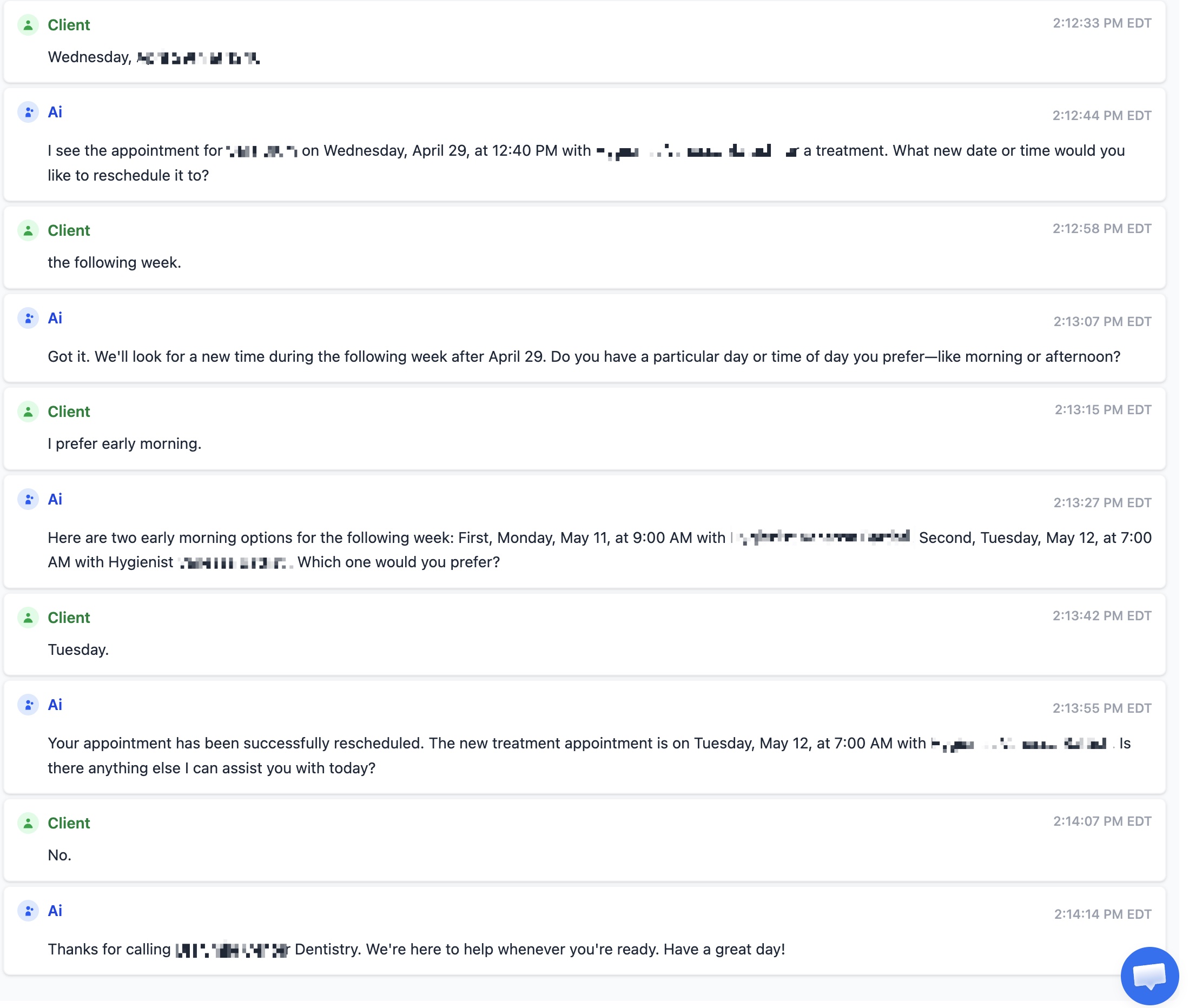
A reschedule conversation from the same practice. The AI pulls up the existing appointment (Apr 29, 12:40 PM), asks the patient’s day-of-week and time-of-day preferences, surfaces two real openings on the schedule, takes the patient’s pick, and writes the new appointment into the dental software. Patient name, provider/hygienist names, and the AI’s receptionist name are blurred at the source. Screenshot taken 2026-05-11.
The thing worth noticing is what the AI didn’t do. It didn’t take a message. It didn’t promise a callback. It didn’t ask the patient to call back during business hours. It read the existing appointment, looked at the actual schedule, offered specific times that were actually available, took the patient’s pick, and wrote the new booking back into Oryx through Oryx’s REST API. The next morning, the front desk opened the schedule and saw a normal-looking rescheduled appointment, with no morning catch-up call required.
This is what we mean when we say the AI is integrated rather than overlaid. An overlay system would have taken a message in this scenario, and a human would have had to call the patient back to actually move the appointment. The patient would have been on hold or on voicemail tag for a day. Most patients in that situation just don’t reschedule. They no-show.
What “30% goal-achieved” actually contains
Across the four practices, the AI reaches goal_achieved = true on roughly 30% of calls in the sampling window. That number deserves unpacking, because it’s lower than the headline a marketing team would write but it’s the honest one.
The wins break down into four shapes. Sometimes the AI booked the appointment directly — patient wanted to book, AI wrote it into ClearDent / Tracker / Oryx, patient hung up satisfied. That’s the smallest share. Booking from a cold call is genuinely hard, and not every configuration is set up to write autonomously. Sometimes the AI answered the question correctly — patient asked “are you open tomorrow,” AI said “we open at 8:30am,” patient hung up. That’s the largest single share of the goal-achieved bucket and the most underrated. Sometimes the AI handled a reschedule end to end, like the transcript above. And sometimes the AI captured a request the front desk could act on — the patient wanted to reschedule but the config doesn’t autonomously reschedule yet, so the AI took the name, current appointment, and preferred new time, and queued it for the morning.
The 70% that didn’t hit goal-achieved breaks down roughly into three shapes too: the caller hung up early before stating their reason (~17%), the conversation ended with the AI not understanding the request (the “abandoned” category, ~25%), or the call was too short or too noisy to classify (~28%).
We’re actively working on the abandoned rate. It’s the single biggest measurable failure mode of the product, and we treat it as a bug — not as a metric to spin. The current best guess is that the AI’s first prompt is asking for too much at once. The shorter the opener, the lower the abandonment. That theory is still in testing.
Why “are you open Saturday” is harder to answer well than it looks
The AI doesn’t have a static FAQ. It reads the practice’s actual hours from the dental software every time it’s asked. For ClearDent and Tracker practices, the hours live in the on-prem SQL Server. For Oryx, in the REST API. For Google Calendar, in the calendar settings themselves. Each dental software integration knows how to read its own source. Holidays, partial-day closures, and the schedule changes the office made yesterday all get picked up automatically.
That sounds boring, and the boring part is the point. A wrong “are you open” answer is worse than no answer at all — it produces a wasted drive and a one-star review. Patients believe what the phone tells them. We had to earn the right to be the thing on the phone, and most of that work is unsexy data plumbing.
Three things patients notice, and one they don’t
From the feedback that gets passed back to us through the clinics, three things come up a lot.
“It picked up right away.” Median pickup across our deployments is under two seconds. The contrast with voicemail or a phone tree is felt immediately, whether or not the patient realizes they’re talking to AI.
“It knew what time you open.” The AI reads the practice’s hours from the dental software live; there’s no separate FAQ for the staff to keep updated. The patient’s question gets the same answer the front desk would have given, but at 9pm on a Sunday.
“It didn’t make me leave a voicemail.” Voicemail is universally hated. The most reliable patient-experience win is the one where leaving a voicemail simply does not happen.
What patients don’t usually notice — and we’re genuinely fine with this — is that it’s AI. About 15–20% of callers in our data clearly identify the AI in the first few seconds. The rest don’t, and we don’t pretend otherwise, but most patients are calling to get an answer, not to grade the voice.
What the practice is actually buying
A practice that runs Xona isn’t buying a marketing feature. They’re buying the answer to one question: what happens when the phone rings and nobody can pick up? Across our production practices, a meaningful share of in-hours calls arrive while staff are already on another line — that question isn’t hypothetical. It’s already happening right now, during lunch, during the post-appointment handoff at the front desk, during the 3pm rush when one person is on hold with insurance and the other is checking out a family of five.
The patient-experience win is the least quantifiable effect of the system, and the most cumulative. Every call that gets answered instead of going to voicemail is one micro-loyalty win. A year of those at a busy practice is the difference between “people call us back” and “we have to chase patients to come back.”
Where we’re still bad at this
Worth saying out loud: we’re not done.
The abandoned category is the open wound. ~25% of calls in the window ended with the AI failing to extract a clear request. We have two working theories. The first is that the AI’s opener is asking for too much at once. We’re testing shorter directive openers (“How can I help — booking, rescheduling, or something else?”) against more open-ended ones (“How can I help you today?”). Early signal says the directive opener reduces abandonment, but increases the rate of callers who immediately ask for a human. There’s no free lunch there. The second theory is that the dental software lookup is sometimes slow enough that the conversation feels off — if Oryx or the on-prem ClearDent tunnel takes 3+ seconds to return service data, the pause between the patient’s question and the AI’s answer becomes noticeable. We’re working on warmer caches and on prompts that don’t need dental software data to be useful.
Neither of these will be the last fix. Phone is a hard product surface, and the AI version is harder.
How a clinic gets here
If you want to know what your own line is doing right now — how many calls are reaching voicemail, what patients are asking for, where the leaks are — we can run that audit. It does not require switching anything. It runs against a forwarded copy of your line for 1–2 weeks; you keep your existing setup intact.
We run reviewed dental-software workflows on ClearDent, Tracker, and Oryx today. For other practice software, we confirm the safest workflow path before any pilot.
Try the estimate first: After-Hours / Overflow ROI Calculator. If the math is interesting, start the free Dental Leakage Scan.